
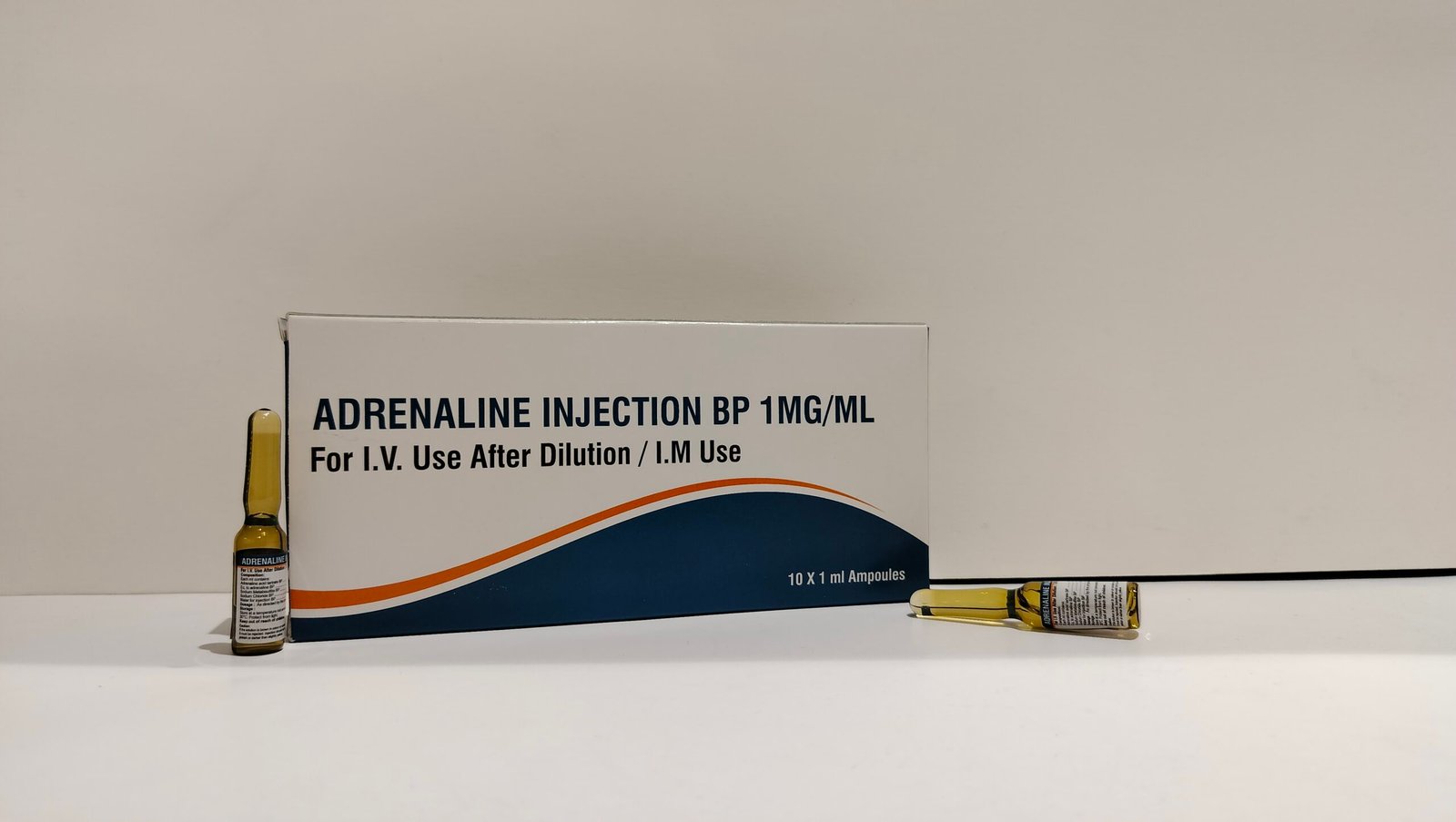
For healthcare-professional education and emergency drug reference.
Generic name: Epinephrine | Common name: Adrenaline | Class: Non-selective α- and β-adrenergic agonist
High-alert medication: Adrenaline is particularly prone to 10-fold dosing errors. Always write the concentration in mg/mL, not only as 1:1000 or 1:10,000.
1. How adrenaline works
| Receptor | Main action | Clinical effect |
|---|---|---|
| α1 | Vasoconstriction | Raises systemic vascular resistance/BP and reduces mucosal oedema |
| β1 | Increases heart rate and contractility | Raises cardiac output |
| β2 | Bronchodilatation | Relieves bronchospasm and reduces mediator release |
2. Common emergency concentrations
| Preparation | Concentration | Typical use |
|---|---|---|
| Adrenaline injection | 1 mg/mL | IM anaphylaxis; nebulisation; infusion preparation |
| Resuscitation syringe | 0.1 mg/mL = 1 mg/10 mL | IV/IO cardiac arrest; pediatric/neonatal resuscitation |
Important: 1 mg/mL and 0.1 mg/mL are 10-fold different concentrations.
3. Universal dose-to-volume formula
Volume required (mL) = prescribed dose (mg) ÷ concentration (mg/mL)
Also remember: 1 mg = 1000 microgram.
4. Anaphylaxis — first-line treatment
For anaphylaxis, adrenaline is given intramuscularly into the anterolateral mid-thigh. Use adrenaline 1 mg/mL. If significant airway, breathing or circulation compromise persists, major resuscitation guidance recommends reassessment and repeat IM dosing at about 5 minutes.
Resuscitation Council UK — Emergency Treatment of Anaphylaxis
Anaphylaxis dose by age — adrenaline 1 mg/mL
| Patient | Dose | Volume |
|---|---|---|
| Adult / >12 years | 500 microgram = 0.5 mg | 0.5 mL IM |
| Small/prepubertal child >12 years | 300 microgram | 0.3 mL IM |
| 6–12 years | 300 microgram = 0.3 mg | 0.3 mL IM |
| 6 months–6 years | 150 microgram = 0.15 mg | 0.15 mL IM |
| <6 months | 100–150 microgram | 0.10–0.15 mL IM |
How to give a very small volume such as 0.1 mL
Use a 1 mL small-volume/tuberculin syringe with fine graduations. If the ampoule contains adrenaline 1 mg/mL, then 0.10 mL contains 0.10 mg = 100 microgram. Draw exactly 0.10 mL, expel visible air, recheck the marking, and inject IM into the anterolateral thigh.
Do not routinely dilute a 0.1–0.15 mL IM dose merely to increase its volume. Unnecessary dilution introduces another opportunity for concentration and decimal-point errors.
Practical adult anaphylaxis case
A 35-year-old man develops urticaria, tongue swelling, wheeze, BP 75/45 mmHg and SpO₂ 88% shortly after an antibiotic.
- Available: adrenaline 1 mg/mL
- Required adult dose: 0.5 mg IM
- Calculation: 0.5 mg ÷ 1 mg/mL = 0.5 mL
- Give 0.5 mL IM into anterolateral mid-thigh
- No dilution required
- Monitor BP, HR, RR, SpO₂, airway swelling, wheeze, mental status and perfusion
Practical child case
An 8-year-old child with anaphylaxis: 0.3 mg = 0.3 mL of 1 mg/mL IM into the anterolateral thigh.
Practical infant case
For an infant requiring 100 microgram: 0.10 mL of 1 mg/mL IM, measured in a 1 mL small-volume syringe.
Anaphylaxis flow
Suspected anaphylaxis
↓
Airway/Breathing/Circulation compromise ± skin/mucosal features
↓
IM adrenaline 1 mg/mL — anterolateral thigh
↓
Oxygen + monitoring + IV access + fluids if shock
↓
Reassess at about 5 min
↓
If significant ABC compromise persists → repeat IM adrenaline
↓
Persistent compromise despite appropriate repeated IM doses → refractory anaphylaxis pathway / senior critical-care support / adrenaline infusion protocol
5. Nebulised adrenaline — severe croup / upper-airway obstruction
A commonly used regimen for life-threatening croup is adrenaline 1 mg/mL, 5 mL nebulised (total 5 mg).
Practical preparation: put the 5 mL directly into the nebuliser chamber. Routine saline dilution is generally not required because 5 mL already provides a practical chamber volume. Add saline only if a specific nebuliser device or local protocol requires a different fill volume; the prescribed adrenaline dose itself should not be reduced.
Royal Children’s Hospital — Croup Guideline
Important: nebulised adrenaline is not a substitute for IM adrenaline in anaphylaxis. It may be an adjunct in upper-airway oedema after systemic treatment.
6. Adult cardiac arrest — IV/IO adrenaline
Current AHA adult advanced life-support guidance uses epinephrine 1 mg IV/IO every 3–5 minutes during cardiac arrest.
AHA — Adult Advanced Life Support
Preferred ready-made preparation
Adrenaline 1 mg/10 mL = 0.1 mg/mL. For one adult arrest dose, give the full 10 mL = 1 mg IV/IO.
If only adrenaline 1 mg/mL ampoule is available
When your institutional emergency protocol permits bedside dilution:
- Take a sterile 10 mL syringe.
- Draw 1 mL adrenaline 1 mg/mL = 1 mg.
- Add 9 mL 0.9% sodium chloride (normal saline).
- Final volume = 10 mL.
- Final concentration = 0.1 mg/mL = 100 microgram/mL.
- Label immediately: ADRENALINE 0.1 mg/mL — IV/IO RESUSCITATION.
Adult arrest dose: give the entire 10 mL = 1 mg IV/IO.
After a peripheral IV dose
Use the resuscitation system’s IV flush protocol and continue high-quality chest compressions without unnecessary interruption. ANZCOR guidance describes a 20–30 mL fluid flush after peripheral IV resuscitation medication.
ANZCOR — Medications in Adult Cardiac Arrest
Practical adult cardiac-arrest case
A 58-year-old patient is in PEA arrest. CPR is ongoing. Available ampoule: adrenaline 1 mg/mL.
- Draw 1 mL adrenaline = 1 mg.
- Add 9 mL normal saline.
- Final = 10 mL of 0.1 mg/mL.
- Give 10 mL IV/IO = 1 mg.
- Flush per protocol and continue CPR.
- Record administration time.
- If arrest persists, repeat 1 mg every 3–5 minutes.
Cardiac-arrest flow
Cardiac arrest confirmed
↓
High-quality CPR + oxygen/ventilation + monitor/defibrillator
↓
Non-shockable rhythm (PEA/asystole) → adrenaline 1 mg IV/IO as soon as feasible → repeat every 3–5 min
Shockable rhythm (VF/pVT) → defibrillation + CPR → adrenaline after initial defibrillation attempts have failed → repeat every 3–5 min
↓
If ROSC occurs → stop routine 1 mg arrest boluses and move to post-cardiac-arrest care.
7. Pediatric cardiac arrest
AHA pediatric dose: 0.01 mg/kg IV/IO using 0.1 mg/mL adrenaline; maximum single dose 1 mg. Repeat every 3–5 minutes during persistent arrest.
AHA — Pediatric Cardiac Arrest Algorithm
Because the solution is 0.1 mg/mL, the practical volume is:
0.1 mL/kg
| Weight | Dose | Volume of 0.1 mg/mL |
|---|---|---|
| 3 kg | 0.03 mg | 0.3 mL |
| 5 kg | 0.05 mg | 0.5 mL |
| 10 kg | 0.10 mg | 1 mL |
| 15 kg | 0.15 mg | 1.5 mL |
| 20 kg | 0.20 mg | 2 mL |
| 30 kg | 0.30 mg | 3 mL |
| 40 kg | 0.40 mg | 4 mL |
| 50 kg | 0.50 mg | 5 mL |
Practical pediatric case
4-year-old child, weight 15 kg:
0.01 mg/kg × 15 = 0.15 mg. At 0.1 mg/mL, volume = 1.5 mL IV/IO.
8. Pediatric severe bradycardia
First correct airway, oxygenation, ventilation and reversible causes. If severe bradycardia with cardiopulmonary compromise persists and the pediatric resuscitation algorithm indicates epinephrine, use 0.01 mg/kg IV/IO of 0.1 mg/mL, maximum 1 mg.
AHA — Pediatric Bradycardia Algorithm
9. Neonatal resuscitation
In a newborn, effective ventilation is the key initial intervention. AHA/AAP neonatal guidance recommends epinephrine when heart rate remains <60/min despite optimized ventilation and chest compressions.
AHA/AAP — Neonatal Resuscitation Guideline
Intravascular neonatal dose
0.01–0.03 mg/kg using 0.1 mg/mL solution.
Practical volume: 0.1–0.3 mL/kg.
Practical 3-kg newborn
- Dose range: 0.03–0.09 mg
- At 0.1 mg/mL: 0.3–0.9 mL intravascularly
- AHA/AAP guidance describes a 3 mL normal-saline flush after intravascular epinephrine.
Endotracheal dose while vascular access is being established
0.05–0.1 mg/kg ET. At 0.1 mg/mL this equals 0.5–1 mL/kg. ET dosing should not delay vascular access because intravascular delivery is more reliable.
Neonatal flow
HR <60/min
↓
Optimize ventilation
↓
Chest compressions as indicated
↓
HR still <60/min
↓
Adrenaline 0.01–0.03 mg/kg intravascular
↓
3 mL NS flush
↓
Reassess HR; repeat every 3–5 min if indicated.
10. Refractory anaphylaxis — infusion
Persistent respiratory or cardiovascular compromise despite appropriate repeated IM adrenaline requires senior/critical-care support and an infusion protocol.
One RCUK preparation is:
Adrenaline 1 mg in 100 mL 0.9% sodium chloride ≈ 10 microgram/mL.
Use an infusion pump through a dedicated line and titrate to clinical response according to the resuscitation protocol.
Continuous ECG and SpO₂ monitoring plus frequent BP measurement are required.
Example: 70-kg adult
At a starting pump rate of 0.5 mL/kg/hour using 10 microgram/mL:
0.5 × 70 = 35 mL/hour, delivering about 5.8 microgram/min. The infusion must then be titrated to response.
11. Adult symptomatic bradycardia with a pulse
For persistent symptomatic adult bradycardia when atropine is ineffective, the AHA algorithm includes epinephrine infusion 2–10 microgram/min, titrated to response.
AHA — Adult Bradycardia Algorithm
Do not confuse this with cardiac arrest: a patient with a pulse and bradycardia does not routinely receive the 1 mg IV cardiac-arrest bolus.
If your hospital uses a standardized concentration of 10 microgram/mL, the pump-rate calculation is:
| Dose | Rate at 10 microgram/mL |
|---|---|
| 2 mcg/min | 12 mL/hour |
| 5 mcg/min | 30 mL/hour |
| 10 mcg/min | 60 mL/hour |
This is a calculation example; use the institution’s approved ICU/pharmacy concentration.
12. Septic shock / severe hypotension
Current US epinephrine prescribing information includes IV infusion for adult septic-shock-associated hypotension at 0.05–2 microgram/kg/min, titrated to the desired MAP.
DailyMed — Adrenalin Prescribing Information
Use the hospital’s standardized vasopressor concentration and pump protocol. Monitor ECG, BP/MAP, HR, peripheral perfusion, urine output and the infusion site.
13. Compatible diluents — practical summary
| Purpose | Example preparation |
|---|---|
| Adult cardiac-arrest syringe | 1 mL adrenaline 1 mg/mL + 9 mL 0.9% NaCl → 10 mL of 0.1 mg/mL |
| RCUK refractory-anaphylaxis infusion | 1 mg in 100 mL 0.9% NaCl |
| Some labelled vasopressor infusions | 5% dextrose or dextrose/sodium-chloride solution according to product/local protocol |
Important incompatibility
Do not mix adrenaline directly with sodium bicarbonate in the same syringe. Adrenaline is unstable in alkaline solutions. If both drugs are required through the same vascular access, use appropriate line flushing/separation according to institutional policy.
14. Contraindications and precautions
In life-threatening anaphylaxis or cardiac arrest, clinically relevant comorbidities should not delay life-saving adrenaline. Current US prescribing information lists no absolute contraindications.
Extra caution and monitoring are warranted in non-arrest patients with major ischemic heart disease, arrhythmia, severe hypertension, hyperthyroidism, pheochromocytoma, diabetes and other conditions in which adrenergic stimulation may be poorly tolerated.
15. Adverse effects
- Tremor, anxiety, palpitations, sweating, headache and pallor
- Tachycardia and hypertension
- Ventricular arrhythmias
- Myocardial ischemia
- Pulmonary oedema in severe toxicity
- Tissue ischemia/necrosis after vasopressor extravasation
16. Monitoring after adrenaline
After IM adrenaline for anaphylaxis
- Respiratory rate
- SpO₂
- Stridor/airway swelling
- Wheeze/air entry
- Heart rate and pulse
- Blood pressure
- Mental status
- Peripheral perfusion
During cardiac arrest
- Cardiac rhythm
- CPR quality
- Pulse at scheduled rhythm checks
- ETCO₂/capnography when an advanced airway is present
- Signs of ROSC
During IV infusion
- Continuous ECG
- Continuous SpO₂
- Frequent/continuous BP and MAP
- Heart rate
- Mental status
- Peripheral perfusion
- Infusion site
- Urine output when relevant
17. Seven-point safety check before administration
- Right patient
- Right indication
- Right dose in mg or microgram
- Right concentration in mg/mL
- Right calculated volume in mL
- Right route
- Right site / infusion method
Also inspect the solution. Do not use a visibly discoloured, cloudy or particulate-containing preparation.
18. Master emergency reference table
| Clinical situation | Preparation | Dose | Practical administration |
|---|---|---|---|
| Adult anaphylaxis | 1 mg/mL | 0.5 mg | 0.5 mL IM thigh |
| 6–12 y anaphylaxis | 1 mg/mL | 0.3 mg | 0.3 mL IM thigh |
| 6 mo–6 y | 1 mg/mL | 0.15 mg | 0.15 mL IM thigh |
| <6 mo | 1 mg/mL | 0.1–0.15 mg | 0.1–0.15 mL IM thigh |
| Severe croup | 1 mg/mL | 5 mg | 5 mL nebulised |
| Adult cardiac arrest | 0.1 mg/mL | 1 mg | 10 mL IV/IO every 3–5 min |
| Pediatric arrest | 0.1 mg/mL | 0.01 mg/kg | 0.1 mL/kg IV/IO; max 1 mg |
| Neonatal intravascular | 0.1 mg/mL | 0.01–0.03 mg/kg | 0.1–0.3 mL/kg |
| Neonatal ET while obtaining access | 0.1 mg/mL | 0.05–0.1 mg/kg | 0.5–1 mL/kg ET |
| Adult symptomatic bradycardia | Infusion | 2–10 mcg/min | Titrate to response |
| Adult septic shock | Infusion | 0.05–2 mcg/kg/min | ICU/vasopressor protocol |
19. Five dangerous adrenaline errors
- Giving 1 mg/mL as a routine IV push in anaphylaxis.
- Confusing 1 mg/mL with 0.1 mg/mL.
- Confusing mg with microgram.
- Giving an adult arrest dose to a child without weight calculation.
- Using adrenaline too early in neonatal resuscitation before effective ventilation is established.
20. Practical memory rule
Anaphylaxis with pulse: 1 mg/mL → IM thigh.
Adult cardiac arrest: 1 mg IV/IO every 3–5 min; common resuscitation syringe 0.1 mg/mL → 10 mL = 1 mg.
Pediatric arrest: 0.1 mg/mL → 0.1 mL/kg.
Neonatal intravascular: 0.1 mg/mL → 0.1–0.3 mL/kg under AHA/AAP guidance.
Severe croup: 1 mg/mL → 5 mL nebulised.
Clinical takeaway
The safe sequence is: identify indication → identify concentration → calculate dose → calculate volume → confirm route → administer → monitor response.
A safe adrenaline order should specify the dose, concentration, volume, route and indication, rather than simply stating “give adrenaline”.
Primary references
- AHA — Adult Advanced Life Support
- AHA — Pediatric Cardiac Arrest Algorithm
- AHA/AAP — Neonatal Resuscitation Guideline
- Resuscitation Council UK — Anaphylaxis Guidance
- DailyMed — Adrenalin Prescribing Information
- Royal Children’s Hospital — Croup Guideline
Medical disclaimer: This material is intended for healthcare-professional education and should be used alongside current institutional resuscitation protocols, approved product information and specialist clinical judgment. Emergency drug concentrations and infusion standards should be standardized locally rather than improvised at the bedside.