
Potassium chloride concentrate must NEVER be administered by direct IV push. It must be diluted, mixed thoroughly and infused with a controlled pump under appropriate monitoring.
Clinical role and indications
Potassium chloride is used to prevent or treat hypokalemia when oral replacement is inadequate, inappropriate or too slow. It replaces potassium; it does not treat the underlying cause of potassium loss.
Marketed formulations and strengths
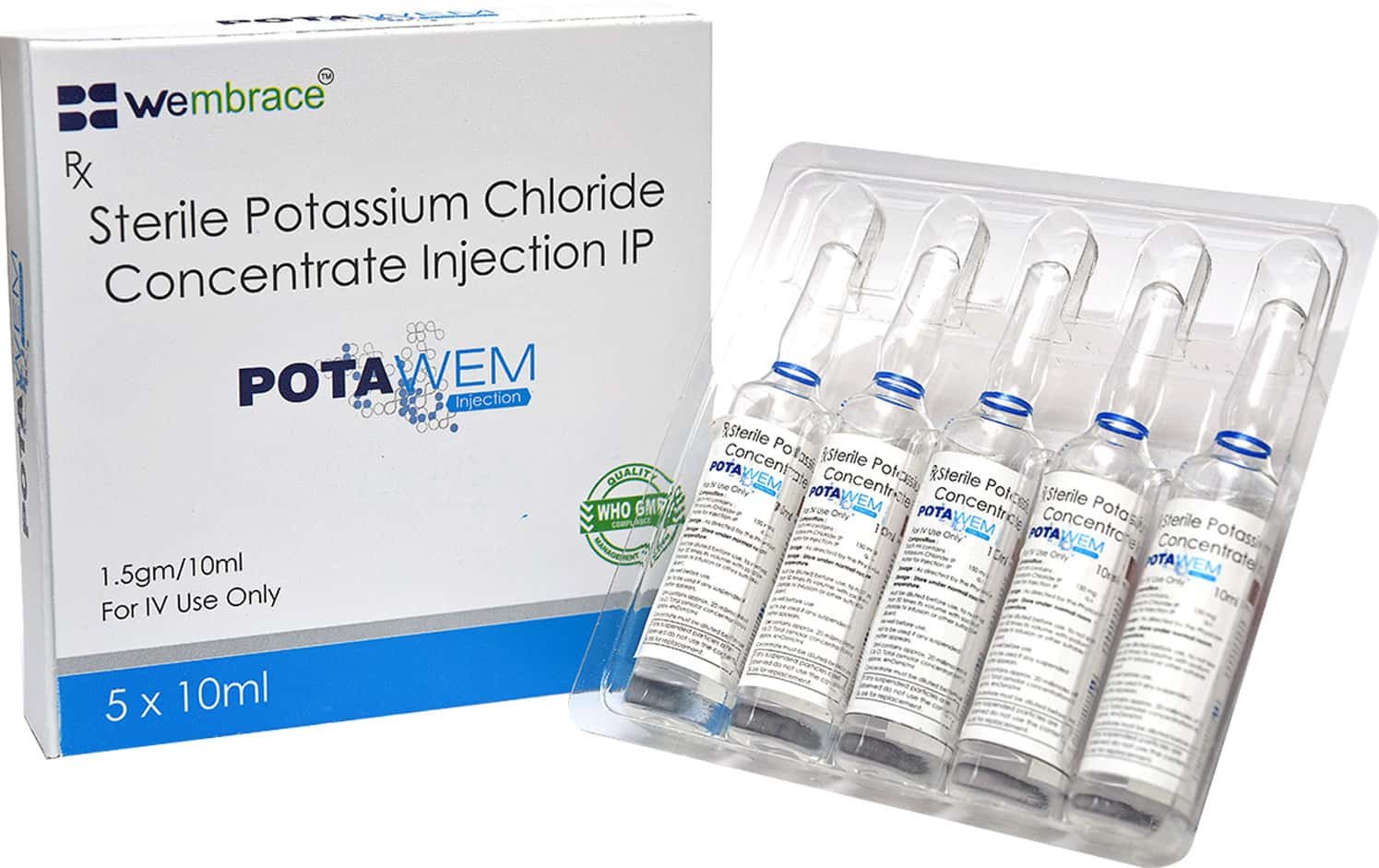
India-market concentrated ampoules commonly include 1.5 g/10 mL (approximately 20 mEq/10 mL), but other concentrations and premixed bags may exist. Always calculate from the label’s stated mEq and mL.
Adult dosing framework
Dose is based on serum potassium, ECG, symptoms, renal function, acid–base status and ongoing losses. For non-emergency replacement, conservative rates are generally preferred. Higher rates require critical-care-level monitoring and institution-specific protocols. The FDA label for highly concentrated potassium chloride requires dilution before administration and stresses controlled infusion.
Verified paediatric dosing
Paediatric IV potassium replacement must be weight-based and protocol-driven, with a maximum concentration and rate defined by age, access type and monitoring environment. Because published limits vary across neonatal and paediatric formularies, the prescriber and pharmacist must verify the current local protocol rather than extrapolate an adult rate.
Calculation example
If an ampoule contains 20 mEq in 10 mL, its concentration is 2 mEq/mL. For an authorised order of 10 mEq: 10 mEq ÷ 2 mEq/mL = 5 mL concentrate. That 5 mL must then be added to the prescribed compatible infusion fluid, mixed and labelled; it is not injected directly.
Reconstitution, dilution and preparation
No reconstitution is required for a liquid concentrate. Dilution is mandatory. Confirm the prescribed final concentration, select a compatible solution according to the exact label/pharmacy reference, add potassium using aseptic technique, invert/mix the container thoroughly and apply a high-alert label.
Route, administration and rate
Administer only by controlled IV infusion. Use a pump. Central access may be required for higher concentrations because peripheral infusion can cause pain and phlebitis. Continuous ECG monitoring is required for rapid or high-dose replacement and for unstable patients.
Storage, stability and compatibility
Store according to the pack. Final admixture stability varies with diluent, concentration, container and manufacturer. Do not combine with incompatible drugs through the same line without a validated compatibility reference.
Renal and hepatic considerations
Reduce or avoid replacement in renal impairment, oliguria or conditions causing impaired potassium excretion. Confirm urine output before substantial replacement. Hepatic disease does not remove the need to assess renal function, acid–base status and interacting medicines.
Pregnancy and lactation
Potassium is a normal body electrolyte; replacement may be used when clinically necessary. Pregnancy/lactation do not justify empirical administration—dose must still be based on documented need and monitoring.
Contraindications and major interactions
Do not use in hyperkalemia or when potassium excretion is severely impaired without specialist management. Major interactions include ACE inhibitors, ARBs, potassium-sparing diuretics, trimethoprim and other medicines that raise potassium. Digoxin-treated patients require particularly careful correction and ECG assessment.
Monitoring
- Repeat serum potassium and magnesium
- Renal function and urine output
- ECG when clinically indicated
- Infusion site and pump settings
- Acid–base status and ongoing gastrointestinal/renal losses
Adverse effects
Common: infusion-site pain, phlebitis and nausea. Serious: hyperkalemia, muscle weakness, paraesthesia, conduction disturbance, ventricular arrhythmia, cardiac arrest and tissue injury after extravasation.
Medication-error and concentration warnings
Errors occur when mEq is confused with mmol or mg, concentrate is mistaken for a ready-to-infuse solution, or an ampoule is injected undiluted. Independent double-checks are strongly recommended.
Official source
FDA label: highly concentrated potassium chloride injection
India availability caveat: Verify the actual product label, concentration, compatible diluent, final concentration and local hospital protocol before use.
Last reviewed: 23 September 2026. For trained healthcare professionals; not individual treatment advice.