
Last reviewed: 26 September 2026.
- Dexamethasone dose is highly indication-specific; a single universal “adult dose” is unsafe.
- Confirm whether the vial is 4 mg/mL, 10 mg/mL or another concentration before calculating volume.
- Repeated or prolonged systemic therapy can suppress the hypothalamic–pituitary–adrenal axis and generally requires planned tapering.
Indications and clinical role
Dexamethasone sodium phosphate injection is a potent glucocorticoid used when rapid systemic or local corticosteroid effect is required, including selected severe inflammatory/allergic conditions, cerebral oedema and other label-defined indications. It is not a substitute for epinephrine in anaphylaxis or for antimicrobial treatment of infection.
Adult and paediatric dosing
The cited label states an initial systemic dose range of 0.5–9 mg/day for many conditions, with lower or higher doses possible depending on disease severity and response. For cerebral oedema, a labelled adult regimen includes 10 mg IV initially followed by 4 mg IM every 6 hours, with reduction after response. This is indication-specific and specialist-directed.
Paediatric dosing must be reduced according to age, weight, condition and indication. For non-operative cerebral oedema, one label notes the smallest effective dose, approximately 0.2 mg/kg/24 hours in divided doses, preferably oral when feasible. Paediatric croup, meningitis, oncology and antiemetic regimens come from indication-specific protocols and must not be inferred from this figure.
Formulations and strengths
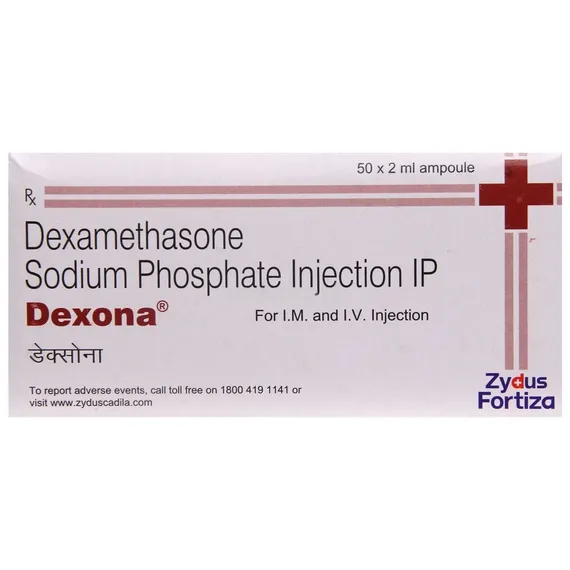
Products may contain dexamethasone sodium phosphate equivalent to 4 mg/mL or other strengths in ampoules/vials. Some multidose products contain preservatives. Indian brands, pack sizes, approved routes and excipients differ; check the CDSCO/local label.
Educational calculation example
A verified prescription calls for 6 mg IV and the ampoule states 4 mg/mL. Volume = 6 ÷ 4 = 1.5 mL. Recalculate from the printed strength every time; do not assume all ampoules have the same concentration.
Preparation and administration
- Routes may include IV, IM, intra-articular, intralesional and soft-tissue injection only where the exact product label permits.
- For IV use, it may be administered directly or further diluted in 0.9% sodium chloride or 5% dextrose when allowed by the manufacturer/local protocol.
- Give slowly according to indication and institutional policy; rapid high-dose administration can increase adverse reactions.
- Use strict aseptic technique for local injection. Do not inject into infected sites or unstable joints.
Storage, stability and compatibility
Store at the temperature and light conditions on the actual label; do not freeze unless specifically permitted. Use diluted solutions within manufacturer/pharmacy stability limits. Do not mix with other medicines in the same syringe or line without validated compatibility information.
Renal and hepatic considerations
No routine renal dose adjustment is usually specified, but fluid/electrolyte effects and comorbidity require monitoring. Hepatic impairment can alter corticosteroid effect; use the lowest effective dose and monitor clinical response. Dialysis does not create a standard replacement dose.
Pregnancy and lactation
Systemic corticosteroids cross the placenta. Use requires indication-specific maternal–fetal benefit–risk assessment. Corticosteroids can appear in human milk and may affect growth or endogenous steroid production with significant exposure; consult current product information.
Contraindications and major interactions
Contraindications include systemic fungal infection and hypersensitivity; live vaccines are generally avoided with immunosuppressive doses. Important interactions include CYP3A4 inducers/inhibitors, antidiabetic medicines, anticoagulants, NSAIDs, diuretics and other agents affecting potassium or immune response.
Monitoring
Monitor clinical response, blood pressure, glucose, electrolytes, infection, mental-state changes, GI symptoms and fluid status. Longer courses require assessment of adrenal suppression, bone health, eye effects, growth in children and a tapering plan.
Adverse effects and medication-error warnings
Common short-term effects include hyperglycaemia, dyspepsia, insomnia, mood change and fluid/electrolyte disturbances. Serious effects include infection masking, psychiatric reactions, GI bleeding/perforation, pancreatitis, severe hypertension, anaphylactoid reactions and adrenal crisis after inappropriate withdrawal.
What is known—and limitations
Label information confirms routes, broad dosing ranges and major precautions. Exact dose, duration, dilution and taper depend on the indication and patient; a broad range must not be converted into an individual treatment recommendation.
Official sources
- DailyMed: dexamethasone sodium phosphate injection
- Pfizer official prescribing information
- FDA label PDF
Related reading
Drug Doses & Preparation A–Z · Adrenaline emergency guide
Educational disclaimer: यह सामग्री सामान्य शिक्षा और official-document interpretation के लिए है। Individual diagnosis, treatment, admission entitlement या legal advice नहीं है; संबंधित authority, clinician और current official document से पुष्टि करें।