
Drug Doses & Preparation | Complete professional monograph and note sheet
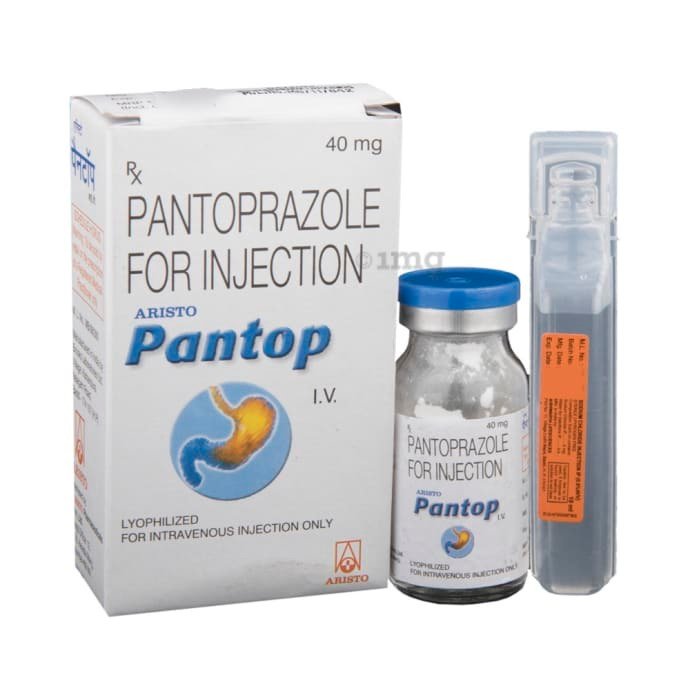
Pantoprazole is a proton-pump inhibitor. Intravenous treatment is generally reserved for patients who cannot use an appropriate oral formulation or for a label-supported specialist indication. Dose, preparation and duration depend on age, weight, indication and the exact product label.
At a Glance
- Typical vial: 40 mg lyophilised powder for IV use.
- Adult GERD/erosive oesophagitis label regimen: 40 mg once daily for up to 10 days, then switch to oral therapy when possible.
- IV injection: over at least 2 minutes; IV infusion: over approximately 15 minutes, according to the cited label.
- Upper-GI bleeding regimens are protocol-specific; do not assume routine approval from the GERD regimen.
Indications and clinical role
The cited official label supports short-term IV treatment of gastro-oesophageal reflux disease with a history of erosive oesophagitis when oral therapy is not appropriate, and pathological hypersecretory conditions including Zollinger–Ellison syndrome. Indications differ between countries and products.
Marketed formulations and strengths
| Dosage form | Typical strength | Check before use |
|---|---|---|
| Powder for injection | 40 mg single-dose vial | Required diluent, final concentration and route |
| Gastro-resistant tablet | 20 mg or 40 mg | Do not crush enteric-coated dosage forms |
| Paediatric oral formulation | Market-dependent | Age approval and product availability |
Verified adult dosing
| Indication | Official-label regimen | Notes |
|---|---|---|
| GERD with erosive oesophagitis when oral use is unsuitable | 40 mg IV once daily for up to 10 days | Switch to an appropriate oral medicine as soon as possible. |
| Pathological hypersecretion | 80 mg IV every 12 hours initially in the cited label | Individualise; specialist monitoring required. Higher-frequency regimens are label-specific. |
Verified paediatric dosing
The current Pfizer label provides age- and weight-based dosing for patients aged 3 months and older for short-term treatment of GERD with erosive oesophagitis when oral therapy is not appropriate. Because bands and formulations can change, use the complete current label table rather than extrapolating an adult dose. Safety and effectiveness for upper-GI bleeding are not established by this label.
Educational calculation example
If a verified 40-mg vial is reconstituted to 4 mg/mL and the authorised dose is 20 mg: 20 mg ÷ 4 mg/mL = 5 mL. This is a calculation demonstration only; confirm the product’s reconstitution volume and paediatric dose band.
Reconstitution, dilution and preparation
- Verify indication, age/weight, allergy history, magnesium where relevant and the exact product.
- Reconstitute the 40-mg vial only with the label-specified volume and diluent; gently mix and inspect.
- For direct IV injection, withdraw the prescribed dose and administer over at least 2 minutes if supported by the product.
- For infusion, further dilute with the label-approved solution; the cited Protonix label uses 100 mL to produce about 0.4 mg/mL and infuses over 15 minutes.
- Do not use cloudy, discoloured or particulate solution. Label dose, concentration, preparation time and beyond-use time.
Storage, stability and compatibility
Store the unopened vial as directed by the manufacturer. Reconstituted and diluted stability varies by brand, diluent, container and temperature; use the actual label and pharmacy policy. Do not mix with another medicine without confirmed compatibility.
Renal and hepatic considerations
Renal impairment generally does not require routine adjustment in adult labelling. Severe hepatic impairment may increase exposure; consult the locally approved label and avoid unnecessary prolonged use.
Pregnancy and lactation
Use during pregnancy only after benefit–risk assessment. Pantoprazole is present in human milk; consider the clinical need, maternal benefit and potential infant effects using current product information.
Contraindications and interactions
Contraindicated in hypersensitivity to pantoprazole, substituted benzimidazoles or formulation components. Important interactions include medicines dependent on gastric pH, high-dose methotrexate, warfarin monitoring considerations and certain antiretrovirals. Review the full label.
Monitoring and adverse effects
- Symptom response and continuing need for IV therapy
- Magnesium with prolonged/risk-prone therapy; B12 and fracture risk with long-term exposure
- Diarrhoea and possible C. difficile infection
- Acute interstitial nephritis, severe cutaneous reactions and hypersensitivity
- Common effects: headache, diarrhoea, nausea and injection-site reactions
Medication-error warnings
- Do not confuse a 40-mg vial with a 40-mg/mL concentration.
- Do not use an empiric GI-bleed regimen as though it were universally label-approved.
- Do not continue IV therapy merely for convenience when oral conversion is suitable.
What is known
Official labelling supports specific short-term IV uses and provides defined reconstitution and administration methods.
Limitations and uncertainties
Indian brands can differ in supplied diluent, stability, approved indications and paediatric information. This guide does not replace an upper-GI-bleed protocol or specialist hypersecretory-disease regimen.
Primary sources
Last reviewed: 28 September 2026