
Generic name: Hydrocortisone sodium succinate for injection | Last reviewed: 29 September 2026
- Use the exact indication-specific regimen and the lowest effective dose.
- Vial strengths and post-reconstitution concentrations differ.
- Rapid IV use is reserved for urgent situations with monitoring.
- Verify the actual product label, concentration and local hospital protocol.
Indications and clinical role
Parenteral glucocorticoid used when oral therapy is not feasible or a rapid systemic corticosteroid effect is required, including adrenal crisis/replacement, severe hypersensitivity as an adjunct after first-line emergency treatment, acute inflammatory disease and selected severe asthma/COPD protocols.
Adult dosing
Dose is indication-specific. Product labelling describes initial systemic doses from 100 mg upward for severe acute conditions, with repeat dosing based on response; adrenal crisis commonly uses 100 mg IV/IM initially followed by protocol-based replacement and fluids. Do not apply one emergency regimen to every indication.
Verified paediatric dosing
The FDA label describes an initial range of 0.56–8 mg/kg/day in 3–4 divided doses (20–240 mg/m²/day), governed by disease severity and response. Paediatric adrenal-crisis and asthma regimens are protocol-specific; use a current paediatric formulary and endocrine/critical-care guidance.
Marketed formulations and strengths
Hydrocortisone sodium succinate powder for injection is supplied in multiple vial strengths, commonly including 100 mg, 250 mg, 500 mg and 1,000 mg internationally. Indian brands and presentations vary; confirm the marketed pack, manufacturer insert and licensed indication.
Educational calculation example
Order: 4 mg/kg/day for a 15 kg child in four divided doses. Daily dose = 4 × 15 = 60 mg/day. Dose every six hours = 60 ÷ 4 = 15 mg. If the verified reconstituted concentration is 50 mg/mL, volume = 15 ÷ 50 = 0.3 mL per dose.
Reconstitution, dilution and preparation
Use the diluent and volume specified for the exact vial. A 100 mg vial may yield 50 mg/mL after reconstitution with 2 mL, but this must not be assumed across brands. Swirl gently until dissolved; use only clear solution. Further dilution for infusion must follow the product label and compatibility policy.
Route, administration method and rate
IV injection, IV infusion or deep IM injection may be authorised depending on the product. For urgent IV administration, follow the label’s minimum administration time and institutional protocol; larger doses require slower administration.
Storage, stability and compatibility
Unopened storage and post-reconstitution stability are manufacturer-specific. One current DailyMed label requires controlled room temperature, light protection and use within 12 hours after preparation. Do not extrapolate this stability to another brand.
Renal and hepatic considerations
No single routine adjustment applies, but fluid retention, blood pressure, glucose, electrolytes and infection risk require closer monitoring in organ dysfunction. Hepatic disease may alter corticosteroid effect.
Pregnancy and lactation
Use when the maternal benefit justifies risk. Systemic corticosteroids cross the placenta and enter breast milk; dose, duration and infant exposure should be considered.
Contraindications and major interactions
Systemic fungal infection and hypersensitivity are major contraindications in product labelling. Live vaccines, strong CYP3A modifiers, NSAIDs, anticoagulants, diuretics, antidiabetics and other immunosuppressants can create clinically important interactions.
Monitoring
Blood pressure, glucose, sodium, potassium, fluid balance, mental status, infection, GI bleeding risk and clinical response. With prolonged therapy monitor weight, eye health, bone risk, growth in children and HPA-axis suppression.
Adverse effects
Common or dose-related effects include hyperglycaemia, sodium/fluid retention, hypertension, mood or sleep change and dyspepsia. Serious risks include infection, GI bleeding, psychiatric reactions, severe electrolyte disturbance, myopathy, ocular complications and adrenal suppression.
Medication-error and concentration warnings
Hydrocortisone base-equivalent dose, vial strength and final concentration can be confused. Do not substitute hydrocortisone acetate suspension for sodium succinate injection. Label every syringe with drug, dose, concentration, route and beyond-use time.
India availability caveat
Hydrocortisone sodium succinate injections are marketed by multiple manufacturers, but pack strengths and instructions differ. Always verify the actual product label, concentration and local hospital protocol.
Official/authoritative sources
- FDA Solu-Cortef prescribing information
- DailyMed Solu-Cortef label
- Zydus hydrocortisone sodium succinate label
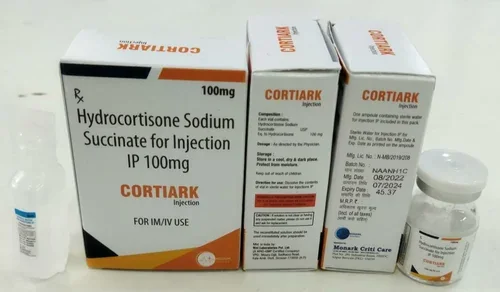
Representative product-image note: Any vial image shown is an educational identification example, not an endorsement.
Educational disclaimer: This monograph supports professional education and does not replace prescribing information, specialist advice or individual treatment decisions.