
Last reviewed: 26 September 2026.
- Gentamicin has a narrow therapeutic window; dose and interval depend on weight, indication, renal function and drug levels.
- Nephrotoxicity, vestibular/auditory toxicity and neuromuscular blockade are major risks.
- Extended-interval regimens must follow a validated local protocol and are not interchangeable with conventional label schedules.
Indications and clinical role
Gentamicin is an aminoglycoside used for serious infections caused by susceptible Gram-negative organisms and selected combination regimens. Obtain cultures when feasible and follow antimicrobial-stewardship guidance; it is not appropriate for uncomplicated viral illness.
Official-label dosing framework
| Group | Label schedule with normal renal function |
|---|---|
| Adults, serious infection | 3 mg/kg/day in three equal doses every 8 hours |
| Life-threatening infection | Up to 5 mg/kg/day in 3–4 divided doses, reduced as soon as clinically indicated |
| Children | 6–7.5 mg/kg/day, usually 2–2.5 mg/kg every 8 hours |
| Infants and neonates | 7.5 mg/kg/day, usually 2.5 mg/kg every 8 hours |
| Premature/full-term neonates ≤1 week | 5 mg/kg/day, usually 2.5 mg/kg every 12 hours |
These are label schedules, not a substitute for local neonatal, sepsis or extended-interval protocols. Obesity, burns, critical illness, pregnancy and changing renal function alter pharmacokinetics.
Marketed formulations and strengths
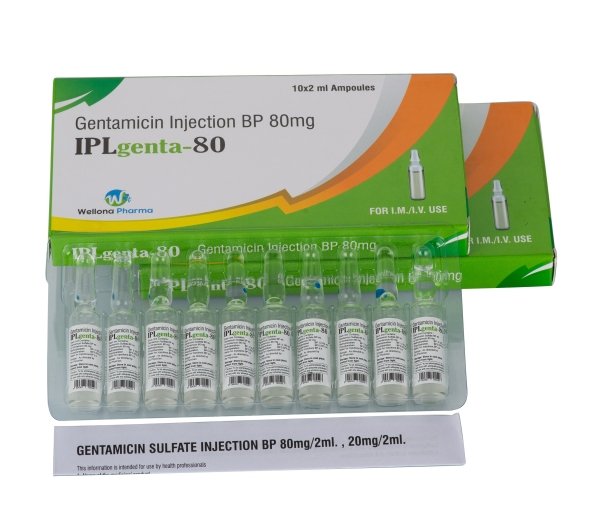
Injectable gentamicin is commonly supplied as gentamicin sulfate equivalent to 10 mg/mL or 40 mg/mL, in ampoules or multidose vials. Indian brands and excipients vary. Check whether the product contains preservatives before neonatal or intrathecal consideration; this guide does not recommend intrathecal use.
Educational calculation example
A 12 kg child prescribed 2.5 mg/kg requires 30 mg. With a verified 40 mg/mL product, volume = 30 ÷ 40 = 0.75 mL. Independent dose/concentration checking is essential; the actual regimen requires renal assessment and local protocol.
Preparation and administration
- Confirm the exact concentration; 10 mg/mL and 40 mg/mL presentations must not be confused.
- For IV infusion, dilute the calculated dose in a compatible volume of 0.9% sodium chloride or 5% dextrose as permitted by the product label and infuse over about 30 minutes to 2 hours.
- IM administration may be used when appropriate. Do not mix in the same solution with beta-lactam antibiotics; use separate administration and flush the line.
- Use aseptic technique and inspect for particles/discolouration.
Storage, stability and compatibility
Store according to the actual pack insert, generally at controlled room temperature and protected as directed. Diluted-solution stability depends on concentration, diluent, container and manufacturer; hospital pharmacy data take priority. Physical/chemical incompatibility with penicillins and cephalosporins can occur in the same container.
Renal and hepatic considerations
Renal: obtain serum creatinine and estimate renal function before therapy and repeatedly during treatment. Reduce exposure by extending the interval and/or adjusting dose using measured concentrations. Dialysis requires a dedicated protocol. Hepatic: no routine hepatic adjustment is defined, but ascites, critical illness and hepatorenal dysfunction can change distribution and clearance.
Pregnancy and lactation
Aminoglycosides cross the placenta and may cause fetal harm; use only when the expected benefit justifies risk. Gentamicin appears in human milk in small amounts, but infant exposure and clinical context should be assessed using the current label and specialist advice.
Contraindications, interactions and monitoring
Contraindicated in serious hypersensitivity to gentamicin/aminoglycosides. Risks increase with other nephrotoxic or ototoxic medicines, potent diuretics and neuromuscular blockers. Monitor cultures/clinical response, renal function, urine output, peak/trough or protocol-defined levels, hearing/vestibular symptoms and neuromuscular status.
Adverse effects and error warnings
Important harms include acute kidney injury, tinnitus, hearing loss, vertigo, neuromuscular blockade, respiratory paralysis and hypersensitivity. Errors arise from wrong weight, confusion between strengths, decimal mistakes, failure to adjust after renal change and mistimed drug levels.
What is known—and limitations
The schedules and principal warnings above come from official labels. Many hospitals use once-daily/extended-interval dosing for selected patients, but eligibility, nomograms and targets differ; this article does not replace that protocol.
Official sources
Related reading
Drug Doses & Preparation A–Z · Vancomycin injection guide
Educational disclaimer: यह सामग्री सामान्य शिक्षा और official-document interpretation के लिए है। Individual diagnosis, treatment, admission entitlement या legal advice नहीं है; संबंधित authority, clinician और current official document से पुष्टि करें।