
- IV vancomycin dosing is weight-, indication-, renal-function- and exposure-guided.
- Never give vancomycin intramuscularly; dilute and infuse slowly to reduce infusion reactions.
- For serious MRSA infection, the IDSA/ASHP/PIDS/SIDP guideline recommends an AUC/MIC target of 400–600 mg·h/L when MIC is assumed to be 1 mg/L.
Clinical role: Intravenous vancomycin is used for susceptible serious Gram-positive infections, including MRSA, when indicated by microbiology, local resistance patterns and stewardship policy. It should not be used for viral illness or when a narrower effective antibiotic is available.
Adult and paediatric dosing
| Patient | Label-based starting dose | Key qualification |
|---|---|---|
| Adults with normal renal function | 2 g/day as 500 mg every 6 hours or 1 g every 12 hours | Individualise by infection, weight, renal function and TDM/AUC |
| Children ≥1 month | 10 mg/kg every 6 hours | Each dose infused over at least 60 minutes; monitor levels/renal function as indicated |
| Neonates | 15 mg/kg loading dose, then 10 mg/kg every 12 hours in first week and every 8 hours thereafter up to 1 month | Longer intervals may be required in premature infants; neonatal protocol and levels are essential |
In renal impairment, extend the interval and/or reduce maintenance exposure using measured kidney function and therapeutic drug monitoring. The referenced label notes an initial dose of at least 15 mg/kg even in renal impairment, but subsequent dosing must be individualised.
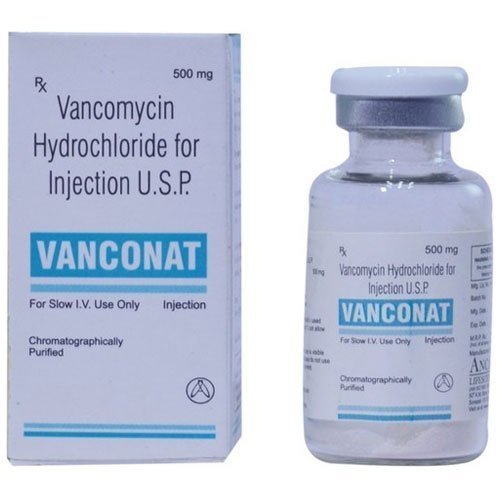
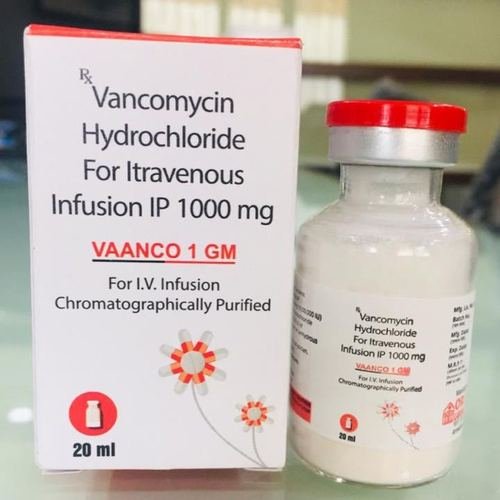
Marketed formulations and India availability
Lyophilised vials commonly contain 500 mg or 1 g vancomycin (as hydrochloride) for reconstitution. Indian brands, manufacturers, vial strengths, excipients and approved indications vary. Confirm the CDSCO/local product label and hospital formulary; a retail listing is only a representative market example, not an endorsement.
Educational calculation example
For a 20 kg child at 10 mg/kg, dose = 200 mg. If the reconstituted concentration is 50 mg/mL, withdraw 200 ÷ 50 = 4 mL. To achieve a final concentration no stronger than 5 mg/mL, total volume should be at least 40 mL. Infuse over at least 60 minutes; the actual regimen must be adjusted for indication, renal function, levels and local protocol.
Reconstitution, dilution and administration
- Reconstitute a 500 mg vial with 10 mL sterile water for injection, or a 1 g vial with 20 mL, to produce 50 mg/mL—only if this matches the actual vial label.
- Further dilute 500 mg in at least 100 mL or 1 g in at least 200 mL of a compatible infusion fluid (about 5 mg/mL). Fluid-restricted patients may require a higher concentration only under an approved protocol because infusion reactions increase.
- IV infusion only. Infuse over at least 60 minutes and use a rate no faster than the product/local protocol permits. Longer infusions are commonly used for larger doses or previous reactions.
- Do not administer intramuscularly. Inspect the solution and use aseptic technique.
Storage, stability and compatibility
The cited label allows refrigerated storage of the reconstituted vial for up to 96 hours, but stability is manufacturer- and diluent-specific; the actual Indian label controls. Listed compatible fluids include 0.9% sodium chloride, 5% dextrose, dextrose/saline and lactated Ringer’s solutions. Vancomycin has a low pH and can be physically incompatible with other drugs; use a separate line or validated compatibility data and flush appropriately.
Renal, hepatic, pregnancy and lactation considerations
- Renal: Measure baseline and serial renal function, review nephrotoxins and individualise maintenance dosing/TDM. Haemodialysis and unstable renal function require specialist protocols.
- Hepatic: No standard hepatic dose adjustment is established for IV vancomycin, but critical illness and combined organ dysfunction can alter exposure.
- Pregnancy/lactation: Use only for a clear indication after benefit–risk assessment. Vancomycin crosses the placenta and is present in human milk; consult current product information and specialist guidance.
Contraindications, interactions and monitoring
Contraindicated in hypersensitivity to vancomycin. Major additive risks occur with nephrotoxic or ototoxic medicines; concomitant anaesthetics can worsen infusion-related reactions. Monitor clinical response, cultures, kidney function, infusion site, hearing symptoms when relevant, blood counts for prolonged therapy and vancomycin exposure.
For serious MRSA infections, the 2020 consensus guideline favours AUC-guided monitoring with a target AUC/MIC of 400–600 mg·h/L (assuming MIC 1 mg/L), achieved early—usually within 24–48 hours. Evidence should not be automatically extrapolated to mild or non-MRSA infections.
Adverse effects and medication-error warnings
Common problems include infusion-site pain/phlebitis and infusion reactions with flushing, pruritus or hypotension. Serious risks include acute kidney injury, ototoxicity, neutropenia, severe skin reactions, anaphylaxis and hypotension/shock with rapid infusion. Errors occur when the 50 mg/mL reconstituted concentrate is confused with the final infusion, dose weight is wrong, kidney function changes, or TDM results are mistimed.
What is known—and limitations
Reconstitution, dilution and baseline schedules above are drawn from official product labels. Modern exposure targets come from a specialist consensus guideline for serious MRSA infections. Exact dose intervals, sampling methods and stability vary by patient, indication, laboratory method and manufacturer; local infectious-disease, pharmacy and neonatal protocols take priority.
Official sources
- DailyMed: vancomycin hydrochloride for injection label
- DailyMed: detailed preparation and administration information
- IDSA/ASHP/PIDS/SIDP vancomycin monitoring guideline
Related reading
Drug Doses & Preparation A–Z directory · Ceftriaxone injection guide
Last reviewed: 25 September 2026.
Medical disclaimer: Educational information for qualified healthcare professionals and learners. It is not individual prescribing advice. Confirm identity, indication, current weight, renal function, cultures, levels, exact vial label and institutional protocol before administration.