
- Verify the actual ampoule concentration before every calculation.
- Monitor respiratory rate, deep-tendon reflexes, urine output, blood pressure and clinical status.
- Keep calcium gluconate and resuscitation support available where obstetric magnesium protocols are used.
Clinical role and indications
Magnesium sulfate is used for prevention and treatment of seizures in severe pre-eclampsia/eclampsia. Depending on the product label and local protocol, it may also be used for documented hypomagnesemia and selected arrhythmias; paediatric asthma use is specialist, protocol-based and generally reserved for severe cases.
Marketed formulations and strengths
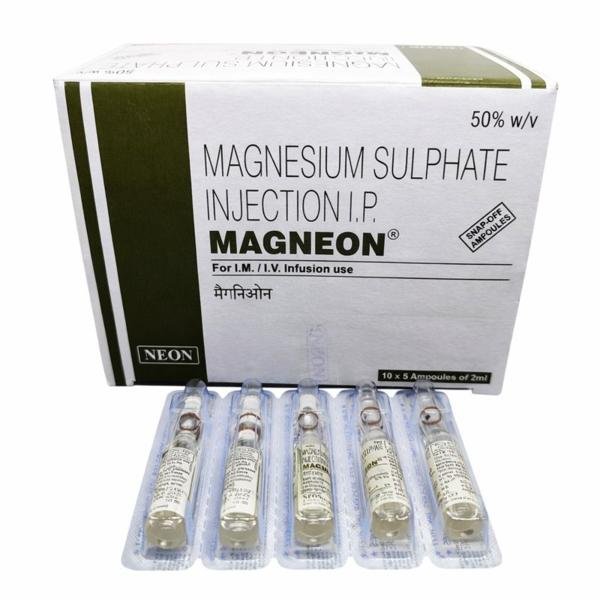
India-market examples include 50% w/v injection (500 mg/mL), commonly in 2 mL or 10 mL ampoules; 20% products may also be encountered. Availability varies. Never infer strength from ampoule size or brand colour.
Adult dosing
Eclampsia/severe pre-eclampsia: Use an approved obstetric regimen such as IV loading followed by maintenance, or a combined IV/IM regimen, exactly as specified by the national/local protocol. Common IV protocols use a 4–6 g loading dose over about 15–30 minutes followed by 1–2 g/hour, but dosing and duration must be prescribed by the treating obstetric team.
Hypomagnesemia/other indications: Dose depends on severity, renal function, serum magnesium and the authorised product label. Rapid empirical boluses can cause hypotension, respiratory depression and cardiac toxicity.
Verified paediatric dosing
There is no single universal paediatric dose for all indications. For severe acute asthma, some authoritative hospital protocols use 25–75 mg/kg IV (maximum commonly 2 g) over 20–30 minutes, but this is specialist-directed and not a routine home or OPD intervention. Neonatal/pediatric hypomagnesemia dosing requires neonatal or paediatric formulary verification.
Calculation example
A 50% w/v solution contains 500 mg/mL. If an authorised order requires 4 g: 4,000 mg ÷ 500 mg/mL = 8 mL. Withdraw 8 mL, then dilute and infuse only according to the approved protocol and infusion concentration.
Reconstitution, dilution and preparation
The injection is a solution and does not require reconstitution. Concentrated 50% solution normally requires dilution for IV infusion. Use the diluent and final concentration specified by the actual product label/local protocol; commonly compatible solutions include 0.9% sodium chloride or 5% dextrose when permitted by the label.
Route, administration and rate
IV infusion should be controlled with an infusion pump. IM administration is regimen-specific and may be painful. Do not give an unverified rapid IV push. Ensure airway support and monitoring are available.
Storage, stability and compatibility
Store as stated on the pack, generally at controlled room temperature and protected from inappropriate heat/freezing. Compatibility and beyond-use time depend on concentration, diluent, container and manufacturer data; do not use a generic stability figure without pharmacy verification.
Renal and hepatic considerations
Magnesium is eliminated mainly by the kidneys. Oliguria or renal impairment substantially increases toxicity risk; maintenance dosing may require reduction or withholding and serum levels may be needed. Hepatic impairment alone is not the principal clearance issue, but clinical instability still requires close monitoring.
Pregnancy and lactation
Magnesium sulfate is an established treatment in pregnancy for eclampsia prevention/treatment when clinically indicated. Prolonged use for unapproved fetal neuroprotection or tocolysis should not be assumed safe. Lactation decisions should follow the authorised label and maternal indication.
Contraindications and major interactions
Contraindications/major cautions can include heart block, significant myocardial damage, hypermagnesemia and severe renal failure unless specialist-supervised. Additive neuromuscular or respiratory depression may occur with neuromuscular blockers, sedatives and other CNS depressants. Calcium-channel blockers require careful haemodynamic monitoring.
Monitoring
- Respiratory rate and oxygenation
- Patellar reflexes
- Urine output and renal function
- Blood pressure, heart rate and mental status
- Serum magnesium when clinically indicated
- Fetal/maternal monitoring in obstetric use
Adverse effects
Common: flushing, warmth, nausea, injection-site discomfort and hypotension. Serious: loss of reflexes, respiratory depression, profound hypotension, bradyarrhythmia, heart block, cardiac arrest and pulmonary oedema in susceptible patients.
Medication-error warnings
Confusing 20% with 50%, confusing grams with milligrams, or setting an infusion rate in mL/hour without checking the final concentration can cause fatal overdose.
Official sources
WHO pre-eclampsia/eclampsia guideline
WHO-prequalified product information: magnesium sulfate 200 mg/mL
India availability caveat: Brands and strengths change. Verify the actual product label, concentration, expiry, compatibility and local hospital protocol before preparation or administration.
Last reviewed: 23 September 2026. For trained healthcare professionals; not individual treatment advice.