
Drug Doses & Preparation | High-alert vasopressor monograph
Norepinephrine (noradrenaline) is a high-alert intravenous vasopressor used to restore blood pressure in severe acute hypotension after adequate assessment and correction of hypovolaemia. It requires continuous monitoring, an infusion pump and immediate management of extravasation or ischaemia.
At a Glance
- Concentrated ampoules must be diluted before infusion unless the product is explicitly supplied ready-to-use.
- Adult label starting range commonly 8–12 micrograms/min, then titrated to haemodynamic response; maintenance commonly 2–4 micrograms/min in the cited label.
- Correct hypovolaemia before or concurrently with treatment.
- Never administer as an unmonitored IV push.
Indications and clinical role
The official label indicates norepinephrine for restoration of blood pressure in adults with severe acute hypotension. In septic shock, contemporary critical-care protocols often use weight-based titration, but the exact concentration, target and line policy must follow the institution.
Marketed formulations and strengths
| Form | Example | Critical warning |
|---|---|---|
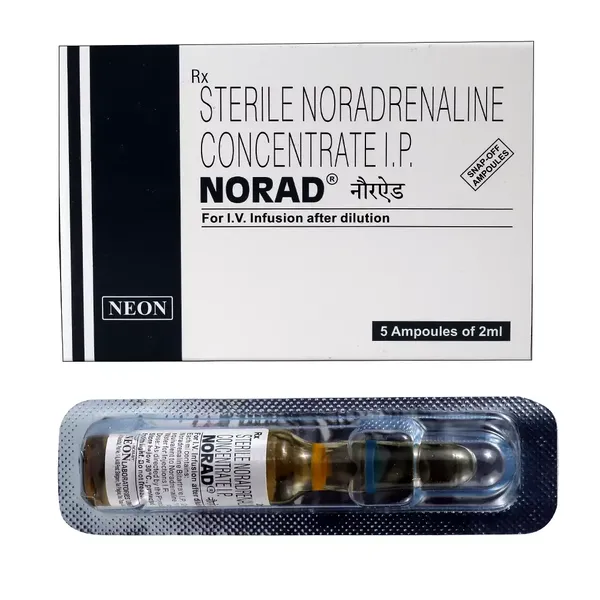
| Concentrate ampoule/vial | 2 mg/2 mL or 4 mg/4 mL presentations may be encountered | Check whether the label states norepinephrine base or bitartrate equivalent. |
| Premixed infusion | Market-dependent | Do not further dilute unless directed. |
Adult dosing
The cited US label describes an initial infusion of 8–12 micrograms/min, titrated to establish and maintain the desired blood pressure, with usual maintenance of 2–4 micrograms/min. Modern ICU protocols may instead prescribe micrograms/kg/min. Do not interchange the two units.
Paediatric dosing
Some institutions use weight-based paediatric infusions, but the cited product label does not provide a universally applicable paediatric regimen. Use a current paediatric critical-care formulary and specialist protocol; do not extrapolate the adult micrograms/minute dose.
Educational calculation example
If a final bag contains 4 mg in 250 mL: 4 mg = 4,000 micrograms; concentration = 16 micrograms/mL. For an order of 8 micrograms/min: 8 ÷ 16 = 0.5 mL/min = 30 mL/hour. This example is not a standard concentration recommendation.
Dilution and preparation
- Confirm the prescribed unit, target, patient weight if relevant, line, concentration and pump library entry.
- Check the ampoule carefully for total drug, volume, base-versus-salt expression and expiry.
- The cited label describes 4 mg in 1,000 mL of 5% dextrose or saline containing 5% dextrose, producing 4 micrograms/mL. Many hospitals use more concentrated standard bags; follow the local approved concentration.
- Mix thoroughly, label prominently as HIGH ALERT and use a smart infusion pump where available.
- Inspect for discoloration or precipitate. Protect from light as directed.
Route and administration
Administer by continuous IV infusion. A central venous catheter is preferred for prolonged or concentrated therapy. If urgent peripheral initiation is permitted, use a large proximal vein, inspect the site frequently and transfer to central access according to protocol. Avoid lower-limb veins in patients with occlusive vascular disease where possible.
Extravasation response
Stop the infusion, leave the catheter available for aspiration, urgently notify the treating team and follow the hospital extravasation protocol. Official labelling describes prompt local infiltration with phentolamine where available and appropriate. Delay can cause tissue necrosis.
Storage, stability and compatibility
The cited label permits the specified diluted solution for up to 24 hours at 20–25°C protected from light. This cannot be transferred automatically to other brands, concentrations, premixes or containers. Avoid alkaline solutions and verify Y-site compatibility through pharmacy resources.
Renal and hepatic considerations
No routine dose table substitutes for titration to haemodynamic effect. Renal or hepatic dysfunction may reflect the underlying shock state and requires close perfusion, lactate, urine-output and organ-function assessment.
Pregnancy and lactation
In life-threatening hypotension, maternal resuscitation takes priority. Norepinephrine can reduce uteroplacental blood flow; use with obstetric and critical-care monitoring. Lactation data are limited, and decisions depend on maternal condition and infant exposure circumstances.
Contraindications, interactions and precautions
Do not use as a substitute for correcting blood-volume deficit except as an emergency temporising measure. Major precautions include peripheral and mesenteric ischaemia, arrhythmias, extravasation and interaction with monoamine oxidase inhibitors, tricyclic antidepressants and other sympathomimetics.
Monitoring
- Continuous blood pressure—preferably arterial in unstable patients
- ECG and heart rate
- Peripheral perfusion, skin, digits and infusion site
- Urine output, lactate, mental status and organ perfusion
- Fluid status and underlying cause of shock
- Exact dose, concentration and pump rate at every handover
Adverse effects and medication errors
Serious effects include hypertension, bradycardia, arrhythmia, myocardial or peripheral ischaemia, pulmonary oedema and tissue necrosis after extravasation. Common errors include confusing mg with micrograms, micrograms/min with micrograms/kg/min, base with salt, and premixed with concentrate.
What is known
Norepinephrine raises vascular tone and blood pressure and is established as a critical vasopressor. Safe administration depends on titration, monitoring and concentration standardisation.
Limitations and uncertainties
This guide does not prescribe a universal septic-shock target, paediatric dose, central-line threshold or concentrated-fluid regimen. These are protocol- and patient-specific.
Primary sources
Last reviewed: 28 September 2026